About the Journal
Simbolismo, a Filipino term (derived from "symbolism" or "symbolisme" originating in late 19th century France), refers to the artistic use of a sign, symbol, or icon with a deeper contextual, social, cultural, political, or personal meaning moving beyond the literal meaning. These signs or symbols reside and are captured in images, texts, narratives or stories, literature, poetry, folk songs, dances, lived experiences, media, visuals, emotions, struggles, and memories and states of mind of individuals, groups, or communities that represent ideas that stand for something bigger.
Simbolismo summons us to question, remember, reflect, and find grounding and meaning in our environments, subcultures, and communities. Simbolismo sanctions us to locate our identity and galvanise our sense of place and positionality in the local communities in which we live, and in the expanding diaspora in which we continue to tread.
Simbolismo offers writers, researchers, and scholars a safe space to share their articles that matter to them and their communities. Recognising multiplicity, plurality, and intersectionality of ideas and knowledge (established or emerging), Simbolismo would like to inspire beginning writers and scholars of semiotics and its related fields to think, write, and publish. Rather than stigmatising beginning writers and scholars, Simbolismo offers them a proactive and supportive review process that promotes inquiry and inclusivity.
A peer-reviewed journal, Simbolismo is free and open access. It is licensed through Creative Commons and published through OJS-PKP (Open Journal Systems – Public Knowledge Project) as the main platform and workflow.
All content published in Simbolismo is under a Creative Commons Attribution NonCommercial 4.0 International CC BY-NC 4.0 license at no cost to authors and will be freely available to readers.
Publisher Registration No: R250508-007 with the National Library Board of Singapore
Current Issue
Vol. 2 No. 2 (2026): Signs, Power, Margins
Signs are everywhere, and yet we rarely stop to ask what they are doing to us. We obey them, inherit them, dispute them, and occasionally, we are broken by them only to rebuild ourselves through them. This issue of Simbolismo: Signs, Identities, Meanings begins precisely here - at the threshold between a sign and the life it shapes. Four original studies, rooted in the Filipino experience and sharpened by semiotic theory, invite readers into a discipline that refuses to treat meaning as accidental, communication as innocent, or power as invisible. What you will encounter in these pages is not semiotics as a rarefied academic pursuit; rather, it is semiotics as a way of seeing the world more sincerely and honestly, and more critically, than we ordinarily dare.
This issue takes the everyday seriously. It asks what a traffic sign in Davao City is really saying, not merely to drivers, but to citizens navigating the unspoken rules of urban authority. It listens to the wind before a typhoon and hears in it something the disaster reports cannot capture: the semiotic life of a people who have learned to find meaning in devastation, resilience in ruin, and identity in the very storms that threaten to erase them. It watches a family's most private conflict unfold on a live screen before millions, and asks who holds the power to name what is right and wrong when the audience becomes the jury. And it follows a teacher to the edge of an island, where the mainland's promises grow faint, and the classroom becomes both a site of struggle and an act of defiance. These are not marginal concerns. They are the concerns of a society trying to understand itself.
The image accompanying this issue is not incidental. Ten days after Typhoon Yolanda devastated Tolosa, Leyte and left nearly two million people without shelter across a region of thirteen million affected, residents gathered in a religious procession, a quiet but resolute assertion that the human capacity for meaning-making endures even when everything else has been taken away. It is an image of loss, yes, but also of the irreducible human impulse to produce new signs even when, especially when, the ground beneath our feet has shifted. It frames this issue not as a collection of academic papers but as a collective act of being a witness to the signs that sustain Filipino life, and to the forces that place that life under perpetual negotiation.
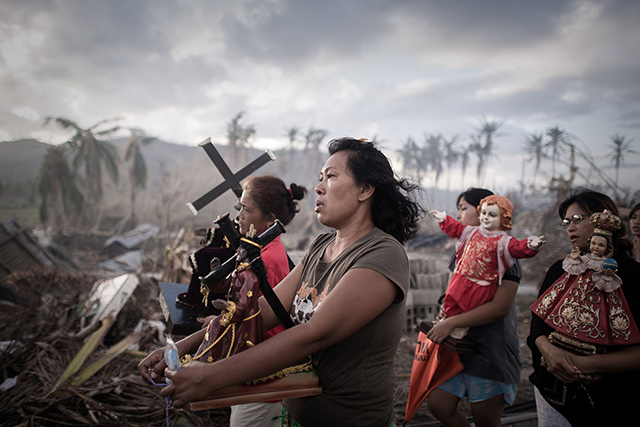
Ten days after Typhoon Yolanda devastated Tolosa, Leyte and left nearly two million people without shelter across a region of thirteen million affected, residents gathered in a religious procession, a quiet but resolute assertion that the human capacity for meaning-making endures even when everything else has been taken away. Photo: AFP/Philippe Lopez
Simbolismo was founded on a simple but demanding premise: that the study of signs is inseparable from the study of power, identity, and what it means to belong to a community, to a language, to a place, and even to the self. The scholars in this issue have met that premise with courage and intellectual generosity. Their work does not resolve the tensions it uncovers; rather, it makes those tensions visible, legible, and therefore available for the kind of critical engagement that scholarship at its best demands. We open our doors with this issue not as a finished statement but as an opening question, in which we hope our readers will carry with them long after the last page.
In This Issue
Meaning in Motion: A Semiotic Study of Traffic Signs in Davao City as the Language of Road Communication. What does a traffic sign govern beyond the movement of vehicles? This study reads the road infrastructure of Davao City as a communicative system saturated with civic authority, spatial ideology, and the unspoken language of urban life, revealing that the most mundane signs are often the most consequential.
When the Wind Whispers: A Semiotic Reading of Resilience in the Filipino Experience of Typhoons. In the wake of destruction, Filipinos do not fall silent; instead, they signify. This study listens carefully to the symbolic language of surviving a typhoon as a natural catastrophe: the gestures, narratives, and communal rituals through which a people transform catastrophe into coherence and suffering into shared identity.
Signs of Conflict and Authority: A Peircean and Social Semiotic Analysis of Mediated Family Dispute in Raffy Tulfo in Action, an Online Public Mediation Program. When a family's conflict becomes a public spectacle, who controls the meaning of what is just and true? This study subjects one of the Philippines' most-watched online mediation programmes to rigorous semiotic scrutiny, exposing the hidden architectures of power, voice, and authority that structure every televised resolution.
Teaching at the Margins: Semiotics, Power, and Meaning in the Lived Experience of an Island Teacher. At the edge of an island, a teacher makes meaning against the grain of institutional indifference and geographic isolation. This study bears witness to that experience by tracing the semiotic dimensions of pedagogy, professional identity, and resistance in a space the centre has long chosen not to see.
I encourage you to read this issue with openness and curiosity.
Enjoy reading!
Published:
2026-06-21
Full Issue
Articles